Disc herniation and disc bulge are things we see every single week in our office.
Most people come in saying, “My back went out,” or “I think I slipped a disc.”
Sometimes it’s in the lower back. Sometimes it’s in the neck. Sometimes it’s traveling into the arm or leg.
And the question we always ask is this: What actually happened to the disc… and why?
Because a disc herniation or disc bulge doesn’t usually happen all at once. It builds. Stress accumulates. Posture changes. Old injuries stack up. The body adapts… until it can’t anymore.
Let’s walk through what that means.
$75 New Patient Special
Includes Initial Consult & Examination, Thorough Medical History, X-Rays (if needed), Complimentary Doctors Report of Findings
How Our Care Plan Works
1. Better
The Better phase is where momentum begins. Here, we stabilize the problem, stop the damage, and activate your body’s natural healing power. By addressing the root cause, we interrupt the downward spiral and initiate forward movement. This is the first push—setting everything in motion and creating the foundation for meaningful transformation that builds with every step forward.
2. Stronger
In the Stronger phase, momentum accelerates. Your body begins to respond, adapt, and rebuild. We retrain your structure, strengthen weakened areas, and improve overall function so your health doesn’t just return—it grows. As your body becomes more stable and capable, each improvement fuels the next, creating a powerful cycle of resilience and lasting strength.
3. Healthier
The Healthier phase is all about maintaining momentum. With the groundwork laid and strength established, we help you stay on a steady path—preventing setbacks, reinforcing progress, and maximizing long-term wellness. This phase ensures the gains you’ve made aren’t just preserved, but multiplied, propelling you into a future of sustained energy, clarity, and health.
What Are Spinal Discs?
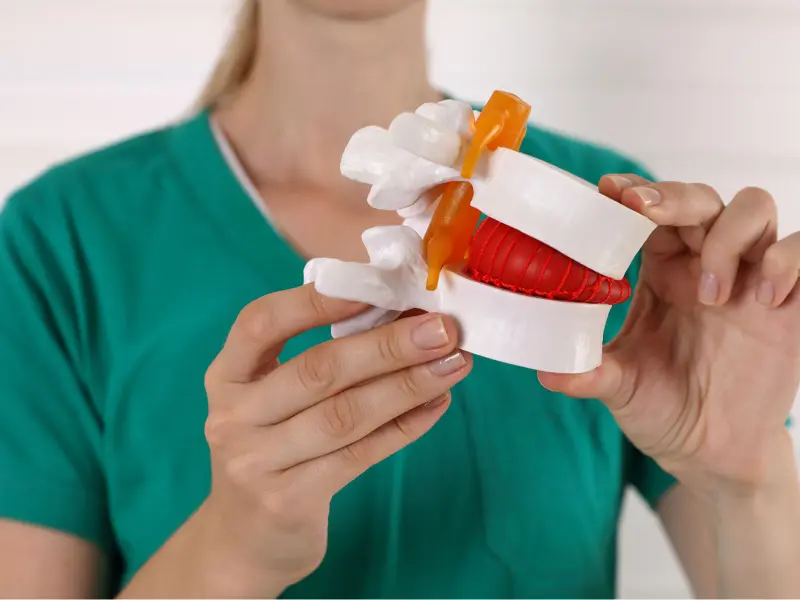
Between each bone of your spine sits a disc. These discs act like cushions and shock absorbers.
They have two main parts:
- A softer inner center
- A stronger outer layer
You can think of a disc like a jelly donut. The center is softer and more flexible. The outer layer keeps it contained and stable.
Discs allow your spine to bend, twist, lift, and move. They also protect your nerves by maintaining space between the spinal bones.
After about age 12, discs no longer have a direct blood supply. They rely on movement to stay hydrated and healthy. When movement decreases, hydration decreases. And when hydration decreases, disc injury becomes more likely.
What Is a Disc Herniation or Disc Bulge?
A disc bulge happens when the outer layer of the disc begins to weaken, and the disc pushes outward beyond its normal boundary.
A disc herniation occurs when the outer layer tears, allowing some of the inner material to protrude further.
Not every disc bulge or disc herniation causes pain. But when the disc compresses a nerve or causes inflammation near a nerve, symptoms begin.
And here’s something important: Only about 10% of the nerves in your spine sense pain. That means a disc herniation or disc bulge can be developing for months or years before symptoms show up.
Pain is usually the last sign, not the first.
What Does a Disc Injury Feel Like?
A disc herniation in the lower back may cause:
- Low back pain
- Pain traveling into the hip or leg
- Numbness or tingling
- Weakness
A disc herniation in the neck may cause:
Sometimes it’s sharp. Sometimes it’s dull and constant. Sometimes it feels unstable or like your back might “give out.”
Disc bulges and disc herniations don’t just affect the area where they occur. They affect how the entire nervous system adapts.
What Causes Disc Herniation and Disc Bulge?
Disc injury is rarely caused by one single event.
It usually involves:
- Repetitive stress
- Prolonged sitting
- Poor posture
- Heavy lifting
- Auto accidents
- Degenerative changes
- Sudden twisting under load
We call it accumulation.
The body compensates for years. Then one small movement becomes “the straw that broke the camel’s back.”
Why Deal With a Disc Injury ASAP?
Because discs don’t heal well when left under pressure.
The longer a disc herniation or disc bulge irritates a nerve, the more inflammation builds. The more inflammation builds, the harder it becomes to reverse.
Early correction gives the disc space to calm down. It reduces stress on the nerve.
It restores healthier movement patterns before degeneration progresses.
Waiting often leads to chronic patterns.
What Happens Anatomically When a Disc Is Injured?
When a disc bulge develops, pressure builds inside the disc.
When a disc herniation occurs, inner disc material pushes outward and can irritate nearby nerves.
Inflammation increases. Muscles tighten to protect the area. Movement decreases. Compensation increases.
Without correction, this cycle continues.
Specific chiropractic adjustments help restore alignment and reduce abnormal stress on the disc.
The goal is not to “pop a disc back in.”
The goal is to restore proper mechanics so the disc can calm down and heal
Conventional vs Chiropractic Approach
Conventional care for disc herniation or disc bulge often focuses on:
- Pain medication
- Anti-inflammatories
- Muscle relaxers
- Injections
- Surgery in severe cases
These may reduce symptoms temporarily.
But they do not address why the disc failed in the first place.
Chiropractic care asks a different question: Why did the disc become stressed and dysfunctional?
If spinal alignment, posture, and nervous system stress are not addressed, disc injury often returns or progresses.
At Revive, we focus on the root cause.
How We Treat Disc Injury in Little Canada, MN
Comprehensive Consultation and Exam
We test. We don’t guess.
Your first visit includes a thorough consultation. We want to understand your history, your habits, your stressors, and how long your spine has been adapting.
Then we perform detailed spinal exams and posture analysis.
We utilize digital X-rays to assess disc spacing, alignment, and degeneration patterns.
We also use INSIGHT scans to evaluate how your nervous system is responding to stress at this moment.
This gives us a complete picture.
Specific Chiropractic Care in Little Canada, MN
Disc herniation and disc bulge almost always involve spinal misalignment and subluxation patterns.
When the spine shifts, discs experience uneven pressure.
By making specific adjustments to the rhythm, we reduce mechanical stress and improve nerve communication.
We regularly re-evaluate progress through objective testing.
We do not chase symptoms. We correct patterns.
Corrective Exercises and Spinal Hygiene
Muscles are slaves to the nerve.
When a disc herniation or disc bulge occurs, surrounding muscles tighten or weaken to compensate.
Corrective exercises retrain the stabilizing muscles around the spine so the disc is not constantly re-injured.
We also focus heavily on:
- Posture correction
- Sitting habits
- Lifting mechanics
- Sleep positioning
Small changes, done consistently, prevent re-aggravation.
We also use wobble-disc motion training and cervical traction support (when appropriate) to help gently rehydrate discs and improve stability.
Discs need movement to heal.
Real Patient Experience
One of our patients shared this after being diagnosed with a disc herniation:
“I was told I had a disc herniation in my lower back and was heading toward injections. I could barely sit through work, and my leg pain was constant. After starting care at Revive, the difference wasn’t just in my pain — it was in how stable and confident my back felt. Over time, my symptoms decreased, I avoided injections, and I finally understood what caused it in the first place.”
We share this not to promise miracles, but to show what happens when the body is given the right environment to heal.
Common Causes of Disc Injury in Little Canada, MN
Repetitive Motion and Stress
Jobs involving prolonged sitting, bending, twisting, or vibration (truck drivers, office workers, healthcare providers) lead to a gradual accumulation of disc stress.
The damage builds silently for years before symptoms appear.
Heavy Lifting
Improper lifting can dramatically increase pressure inside the disc.
When combined with poor posture, it increases the risk of disc herniation or disc bulge.
Proper lifting involves hip-hinge mechanics and core stability—not rounding the spine.
Auto Accidents
Whiplash injuries can cause both cervical disc herniation and lumbar disc bulge.
Even low-speed collisions create significant force through the spine.
We always recommend evaluation after an accident, even if symptoms are mild.
Degenerative Disc Disease
Degenerative disc disease is a long-term disc dehydration and stress.
As discs lose height, they lose their ability to absorb shock.
Care focuses on improving mechanics to slow progression.
Respiratory Illness and Chronic Cough
Repeated forceful coughing increases pressure inside discs.
If someone already has weakened discs, this can trigger a disc herniation.
Check Out Our Location Near You
125 Little Canada Rd W #115, Little Canada, MN 55117
Frequently Asked Questions
Is it safe to see a chiropractor with a disc herniation?
Yes. When properly evaluated and treated specifically, chiropractic care is one of the most conservative and effective approaches for disc herniation.
Can a chiropractor put a disc back in place?
No. Discs do not “pop back in.” We restore spinal mechanics so the disc can heal naturally.
How long does a disc herniation take to heal?
It depends on the severity and how long it has been present. Many disc bulges improve within weeks to months when properly supported.
What should you not do with a disc herniation?
Avoid prolonged sitting, heavy lifting with poor form, and random aggressive stretching.
Can chiropractors fix a pinched nerve?
We reduce the pressure causing the nerve irritation by restoring alignment and mechanics.
$75 New Patient Special
Includes Initial Consult & Examination, Thorough Medical History, X-Rays (if needed), Complimentary Doctors Report of Findings