Low back pain is one of the most common issues we see at Revive—and it’s no surprise. Around 80% of people will experience low back pain at some point in their lives, and it remains the leading cause of disability in the U.S.
The reason? Your lower back (lumbar spine) is under constant stress. Whether it’s sitting for long hours, old injuries, poor posture, or improper movement patterns, this area takes the brunt of it. Those stressors cause subluxation (misalignments) in the lumbar spine. Left unaddressed, those subluxations get worse over time. This causes excessive wear and tear on your muscles, ligaments, joints, and discs, leading to pain, dysfunction, and degeneration.
At Revive, we don’t just chase symptoms. We help you get to the root cause so your body can function the way God designed it to, restoring your ability to be resilient and move through life with strength and confidence.
We’ve helped countless individuals who had an accident or sports injury years ago and never fully recovered. What started as a small issue eventually snowballed into long-term damage. That’s why early correction matters.
When low back pain is left unaddressed, it can:
- Interfere with your daily life and mobility
- Cause muscles to weaken and joints to degenerate
- Lead to chronic pain, stress, and emotional fatigue
- Impact your ability to do the things you love with the people who matter most
But there is hope. Our care focuses on correcting the problem, not masking it—so your body can begin to heal, just as it was created to.
We believe you were made to live better, stronger, healthier—and that starts with a nervous system that’s functioning at its best.
If you’re experiencing low back pain, don’t wait. The earlier you address it, the easier it is to restore function and prevent long-term damage.
You were made to move. You were made to heal. Let’s get you there—together.
$75 New Patient Special
Includes Initial Consult & Examination, Thorough Medical History, X-Rays (if needed), Complimentary Doctors Report of Findings
How Our Care Plan Works
1. Better
The Better phase is where momentum begins. Here, we stabilize the problem, stop the damage, and activate your body’s natural healing power. By addressing the root cause, we interrupt the downward spiral and initiate forward movement. This is the first push—setting everything in motion and creating the foundation for meaningful transformation that builds with every step forward.
2. Stronger
In the Stronger phase, momentum accelerates. Your body begins to respond, adapt, and rebuild. We retrain your structure, strengthen weakened areas, and improve overall function so your health doesn’t just return—it grows. As your body becomes more stable and capable, each improvement fuels the next, creating a powerful cycle of resilience and lasting strength.
3. Healthier
The Healthier phase is all about maintaining momentum. With the groundwork laid and strength established, we help you stay on a steady path—preventing setbacks, reinforcing progress, and maximizing long-term wellness. This phase ensures the gains you’ve made aren’t just preserved, but multiplied, propelling you into a future of sustained energy, clarity, and health.
How We Treat Lower Back Pain In Little Canada, MN
Comprehensive Consultation and Exam
At Revive, everything starts with truly listening.
When it comes to low back pain—or any concern—you deserve a provider who will take the time to hear your story. Many of our patients tell us they’ve felt overlooked or dismissed in the past. That’s why your first visit begins with a comprehensive consultation and detailed history, so we can understand not just your symptoms, but the complete picture of what your body has been through and how it’s been affecting your health and your life.
We’ll ask detailed questions about your daily habits, activities, past injuries, posture, stress, and more—because every detail matters when it comes to finding the truth behind the pain.
After that, we perform a thorough exam that may include:
- Range of Motion Testing
- Postural and Bilateral Balance Observations
- Complete Spinal and Neurological Evaluation
- Digital X-rays (if necessary)
We use objective testing and imaging to get a clear picture of what’s going on inside your body and make the most accurate recommendations possible.
Our goal? To find the root cause of your issue—not just manage symptoms, but correct the underlying problem so you can heal the way God designed you to.
Pain is often a signal, not the source. Whether it’s a spinal misalignment, muscle imbalance, or nerve interference, identifying what’s really going on allows us to build a personalized plan that brings lasting change.
This kind of care isn’t one-size-fits-all. It’s specific, intentional, and focused on long-term results. When your nervous system functions the way it was created to, your body becomes more resilient, ready to move and live better, stronger, and healthier than before.
At Revive, we’re not just here to help you feel better—we’re here to help you heal better.

Digital X-rays
At Revive, we believe in getting to the root cause—not guessing. That’s why we take X-rays as a vital part of your evaluation.
To see is to know. To not see is to guess. We don’t guess when it comes to your health.
X-rays give us a clear window into the structure of your spine and allow us to identify spinal misalignments, degeneration, arthritis, past injuries, and other underlying issues that may be contributing to your low back pain. When we can see what’s going on, we can clearly understand what your body needs to heal the way it was designed to. We base our recommendations on our findings and your goals, so we always tailor your care to what your body needs and where you want to go.
While X-rays do involve a minimal amount of radiation, they are not dangerous. In fact, the amount of radiation used is extremely low, often less than what you’d get flying on a plane or spending a day in the sun. Modern digital imaging technology minimizes exposure even further, making X-rays a safe, powerful, and essential tool for seeing what’s really going on beneath the surface.
When we see the full picture, we are empowered to make the best decisions for your health and your future together. It’s just one more way we equip your body to become more resilient, restore what’s been lost, and live in alignment with how you were created.
Specific Chiropractic Care in Little Canada, MN
At Revive, the most important thing we do for people dealing with low back pain is provide specific chiropractic care, because most spinal dysfunction starts with something called subluxation.
A subluxation occurs when one or more bones in the spine shift out of proper alignment or lose healthy movement. This puts stress on the nerves, interferes with the communication between the brain and body, and prevents the body from functioning and healing as it was created to.
In the lower back, this can lead to discomfort, stiffness, or limited movement, preventing your body from working the way it was designed to. It can even cause symptoms like sciatica—burning, tingling, or pain that travels down one or both legs. And because the body is one interconnected system, subluxations can trigger compensation patterns, affecting posture, muscles, and joints in other areas over time.
Correcting subluxations through specific, corrective chiropractic adjustments is key to your healing. When we restore proper alignment and movement, we relieve stress on your nervous system, which reduces pain and helps your body function the way it was created to.
For many, our approach means less dependency on medications, avoiding invasive treatments, and reclaiming the health they didn’t think was possible.

3-Legged Stool of Correction
1. Adjustments In Rhythm: Your low back is the largest and most weight-bearing part of your spine, which means it often takes the brunt of daily stress and strain. That wear and tear doesn’t happen overnight… and neither does true healing.
At Revive, we know that restoring proper function in the low back takes more than just a few quick fixes. It requires consistency. That’s why adjustments in rhythm are essential. When we deliver care in a rhythm explicitly designed for your body—based on your age, health history, lifestyle, exam findings, and goals—we are able to shift the momentum from breakdown to breakthrough. This is where correction begins and lasting change takes root.
2. Breaking Bad Habits: When it comes to low back pain, it’s not just about what’s hurting; it’s about what’s causing the hurt. Many of the aches and pains we feel are the result of daily habits that create stress and damage in our spine over time.
At Revive, we believe healing starts by replacing what’s breaking you down with what builds you up. That means recognizing the habits that are working against your health and choosing new ones that support the way your body was designed to move, heal, and thrive. Sometimes, the first step is simply starting better habits—standing taller, moving more, sitting less. Little by little, better choices lead to better results…and a stronger, healthier back.
3. Corrective Exercises: Just like you’d rehab a sprained ankle or injured shoulder, your spine needs specific, focused care when it’s not functioning the way it was designed to. If there’s dysfunction in the spine, we can’t ignore it—we need to actively retrain and restore it.
That’s where corrective spinal rehab comes in. These targeted exercises and stretches are designed to rebuild strength, restore mobility, and support long-term correction.
When we combine adjustments with the right movement strategies, we accelerate healing and help your spine hold its correction longer. The result? Greater stability, fewer injuries, and a higher quality of life—because when your spine works right, your whole body works better.
Spinal Hygiene
We all understand the importance of brushing and flossing our teeth to prevent decay. We don’t wait until our teeth are falling out to start caring for them—we’re taught to be proactive from a young age.
Your lower back deserves the same kind of daily attention. That’s why at Revive, we equip our practice members with simple spinal hygiene exercises—intentional movements designed to keep the low back strong, mobile, and aligned. These take just a few minutes, but when done consistently, they support healing, prevent future injury, and help your body function the way God designed it to.
We only get one spine, and the low back plays a vital role in how we move, feel, and live. Let’s learn to care for it proactively—not reactively—and teach our kids to do the same, so we can protect what matters most for generations to come.
Common Causes of Low Back Pain in Little Canada, MN
Bulged Lumbar Discs
Think of the disc as a cushion between each bone in your spine—designed by God to give you both stability and movement. When the spine loses its proper alignment, especially in the low back, it puts uneven pressure on these discs. Over time—or from a specific trauma like a car accident—that pressure can cause the disc to bulge, much like squeezing a water balloon.
A bulging disc irritates nearby nerves, leading to inflammation, interference in nerve communication, and symptoms like pain, numbness, tingling, or even weakness in the back, hip, or leg. Many people have disc bulges and don’t even know it—until the pressure progresses so much onto the nerve that it finally starts to cause pain, limitation, and problems like sciatica.
Unfortunately, most treatments today only cover up the symptoms—using pain meds, injections, or even surgery—without addressing the real cause: misalignment in the spine. Through corrective chiropractic care and specific testing like digital X-rays, we find where that specific pressure is coming from and help restore alignment, remove interference, and give the disc space to heal naturally, without drugs or surgery.
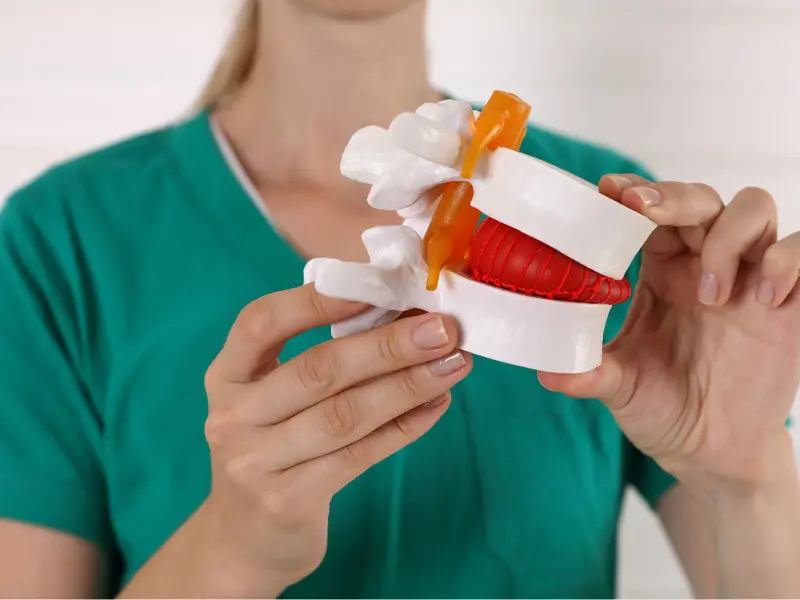
Herniated Lumbar Discs
A disc bulge and a disc herniation both involve problems with the intervertebral discs (the soft cushions between your spinal bones), but they differ in severity, structure, and impact on nearby nerves.
One of the more serious reasons people experience low back pain is a disc herniation. This happens when the gel-like center of a spinal disc pushes through a tear in its outer layer, like a jelly donut that’s been squeezed too hard. That leaked material can put pressure on nearby nerves, often leading to pain, numbness, tingling, or weakness in the low back, hip, leg, or foot.
While disc herniations can be triggered by a big event—like lifting something heavy or a traumatic injury—most develop slowly over time due to poor posture, spinal misalignment, and wear and tear. Unfortunately, most treatments today only focus on managing symptoms. Medications, injections, stretching, or even surgery may mask the pain, but they don’t correct the misalignment that caused the disc to herniate in the first place.
There is a time and place for surgery in extreme cases of disc herniation, especially when nerve damage is at risk. However, for many people, the next best step is to address the root cause so it doesn’t keep coming back or lead to further breakdown.
At Revive, we do just that. Through advanced tools like digital X-rays and customized corrective care, we pinpoint the exact areas of misalignment, restore balance to the spine, and take pressure off the discs, especially in the lower back. This allows inflammation to reduce, nerves to heal, and the body to function the way God designed it to. We don’t just want you out of pain—we want you living strong, mobile, and fully alive.
Degenerative Disc Disease
Despite the name, Degenerative Disc Disease (DDD) isn’t actually a disease—it’s a way to describe the wear and tear that happens to the discs in your spine over time. These discs act like little shock absorbers between each bone in your spine, especially in your lower back. As we age—or more accurately, as our spine experiences years of poor posture, stress, repetitive movement, and misalignment—these discs can begin to break down. They lose hydration, become thinner, and may even start to crack or bulge, leading to stiffness, pain, or even nerve issues like numbness and tingling in the hips or legs.
What’s important to know is that not every disc wears out evenly. It’s usually the ones that have been under the most stress, typically due to a misalignment that’s been left uncorrected for years. That’s why DDD doesn’t strike every disc in your spine all at once. If we can understand why that one area wore out faster, we can often prevent future damage and restore function.
At Revive, we help patients with DDD by focusing on the root cause—not just the symptoms. While many people take medications, injections, or even undergo surgery, those approaches only manage pain. They don’t fix the misalignment that caused the damage in the first place. Through digital X-rays, corrective chiropractic adjustments, spinal rehab, and personalized care, we work to restore healthy motion and take pressure off the damaged disc, giving your body the chance to heal the way God designed it to.
Surgery may be necessary in rare, advanced cases—but even then, it’s crucial to correct the original problem to prevent it from coming back in the future. Whether you’re dealing with chronic low back pain, reduced flexibility, or signs of nerve pressure, the answer isn’t just to manage pain—it’s to get to the root, so you can live fully, move freely, and stay strong for years to come.
Spinal Stenosis
Spinal stenosis happens when the spaces in your spine begin to narrow, particularly in the spinal canal or where the nerves exit between the bones. Imagine your spine as a tunnel that houses your spinal cord and nerves. Over time, due to age, arthritis, misalignment, or disc degeneration, that tunnel begins to tighten. When this happens (stenosis) in your low back (lumbar spine), it can put pressure on the nerves, causing pain, numbness, tingling, or even heaviness in your legs, especially when you walk or stand for too long. Many people notice they feel better when they sit down or lean forward, like over a shopping cart, because it opens up those narrowed spaces and gives the nerves a break.
At Revive, we focus on getting to the root cause of that narrowing—often misalignment, loss of disc height, or poor mechanics that have added pressure to the spine over time. Instead of just masking symptoms with pain relievers or injections, we use corrective chiropractic adjustments, gentle traction techniques like flexion-distraction, and custom rehab exercises to restore alignment, create more space for your nerves, and help your body heal. Surgery is sometimes recommended in severe cases, but many patients find real, lasting relief through our natural, non-invasive care so that they can walk, move, and live without fear of the pain coming back.
Muscle Strain
A muscle strain in the low back—what many people call “pulling a muscle”—happens when the muscle fibers are overstretched or even torn from lifting, twisting, or moving the wrong way. It can also come from overuse, poor posture, or simply not having enough support from your core. Some strains feel like a mild ache or tightness, while others can cause sharp pain, swelling, or even bruising. One of the most common things I see in our office is someone hurting their lower back by lifting without bracing their core or twisting awkwardly.
It’s important to remember that muscles are slaves to the nerve. When there’s pressure on the nerves in your low back—whether it’s from misalignments or disc issues—the muscles become vulnerable. This pressure can make muscles feel tight, weak, or painful, but it’s often a sign of a bigger, underlying problem: a nerve issue. That’s why when we see muscle strain, we don’t just treat the muscle—we assess the nerve, spine, and posture to find the root cause.
Muscle strains do heal, but they go through stages. First, your body sends inflammation to clean up the damage. Then, it starts rebuilding muscle fibers, and finally, it strengthens and remodels the area. That’s where our care at Revive makes a big difference. We support healing with adjustments, soft tissue work, rehab exercises, and coaching on how to move better so you don’t keep re-injuring the area.
It’s also important to know that not every “muscle strain” is just a muscle problem. Sometimes joint misalignments, disc issues, or nerve irritation can feel like a pulled muscle, so we take the time to assess the whole picture.
Sacroiliac Joint Dysfunction (SI Joint Pain)
At Revive, we understand that the sacroiliac (SI) joint, located at the base of your spine where the sacrum meets the iliac bones of your pelvis, plays a vital role in your body’s function. While it only moves a few millimeters, that small movement is crucial for absorbing shock and providing stability as it helps transfer forces between your upper body and legs. This joint acts like a shock absorber, supporting your spine while enabling smooth movement.
When the SI joint becomes stiff, restricted, or too loose, often due to injury, pregnancy, or repetitive stress, it can lead to pain. This discomfort can feel like sharp or aching pain near the base of your spine, which may radiate into your hip, buttock, or even groin. Many people mistakenly think it’s typical low back pain or sciatica, but the SI joint is often the true source. When the joint isn’t functioning properly, surrounding muscles and ligaments have to pick up the slack, leading to further pain and stiffness.
At Revive, we focus on restoring the proper motion, alignment, and stability of your SI joint. Our approach includes gentle chiropractic adjustments to reduce pressure, soft tissue work to release tension in the pelvis and low back, stability exercises to strengthen your core and pelvic muscles, and coaching on postural and movement habits to ease strain on the joint.
We see many people come in struggling with SI joint pain, and they find great relief and lasting results through our specific corrective chiropractic care. By focusing on the root cause and restoring balance and function, we help our patients experience lasting results and get back to enjoying their lives without constant discomfort.
Facet Joint Dysfunction
Facet joints are small joints in your spine that act like hinges, helping you bend, twist, and extend while keeping the spine stable. In your low back, these joints play a key role in supporting weight and allowing flexibility. However, they can become a source of pain if they become irritated, restricted, or stop moving properly. This can lead to sharp, localized pain in the lower back, often just on one side, and may cause discomfort when leaning back, twisting, or after sitting for long periods. You might also experience stiffness in the morning or feel “locked up.” This pain is commonly triggered by repetitive bending, lifting, poor posture, or wear and tear over time.
At Revive, we focus on specific, corrective chiropractic care to restore proper movement and function to your facet joints. We use precise spinal adjustments to relieve irritation and improve mobility, often offering immediate relief. We also teach stabilization exercises to strengthen the core and hips, ensuring the joints stay supported. Additionally, we coach you on how to move smarter throughout the day, whether you’re sitting, standing, or lifting.
In most cases, with the right combination of adjustments, rehab exercises, and movement coaching, we can help you feel better, move better, heal better, and stay better without the need for surgery or medication. By addressing the root cause of facet issues – misalignment – we empower you to see lasting change and real results.
Subluxation
What is a Subluxation?
We talk a lot about the root cause — and this is it.
A subluxation is a misalignment or dysfunction in your spine that interferes with the way your body moves, feels, and heals. It’s not a complete dislocation, but even small shifts can have a significant impact. When a spinal joint isn’t working the way God designed it to, it creates stress on your nervous system — the system in charge of everything from pain signals to organ function.
Whether it’s in your low back or anywhere in your spine, subluxation affects the brain-body connection. And when that connection is off, your body can’t function the way it was created to. You might feel pain, tightness, fatigue, or even struggle with issues that seem unrelated, because every function in your body is connected through your spine and nervous system.
Subluxations create a ripple effect in the body. When a spinal joint is misaligned and not moving properly, it can:
- Irritate nearby nerves, leading to pain, tingling, or weakness
- Cause muscle tightness or spasms
- Alter your posture and movement patterns
- Lead to joint degeneration over time
- Disrupt the way your brain and body communicate through the nervous system
Even if you don’t feel pain right away, a subluxation can limit your performance, weaken your body’s natural defenses, and set you up for injury down the road. That’s why we focus not just on pain relief, but on restoring optimal function.
How Do You Find and Correct Subluxations?
At Revive, we don’t guess — we assess. We use hands-on testing, posture and movement analysis, and if needed, imaging to find where subluxations are holding your body back.
Then we apply our 3-legged stool of correction approach:
1. Specific Chiropractic Adjustments – To restore proper motion and relieve nerve pressure.
2. Breaking Bad Habits – We help you shift how you move, sit, and function in daily life to reduce stress on the spine.
3. Corrective Exercises – To rebuild strength and stability, so your adjustments hold and your body gets stronger.
This process doesn’t just relieve pain — it restores function, rewires how your body moves, and sets you up for long-term healing. We make sure you not only get well, but stay well.
A chiropractic adjustment does more than just move a bone — it’s like hitting the reset button on your nervous system. Your body was designed to heal, and chiropractic simply removes the interference. Each adjustment isn’t just about a “pop” or a quick fix. It’s a purposeful reset for your nervous system.
Adjustments help:
- Relieve pressure on nerves
- Reduce muscle tension and inflammation
- Restore normal movement patterns
- Improve your brain-body communication
- Trigger a cascade of healing — improved circulation, better posture, even stress relief
When we restore motion in your spine, your brain and body can communicate clearly again. That’s when healing happens. You feel more mobile, more grounded, more like you. Your energy increases. You sleep better. Your body functions better — because we’ve cleared the path for it to do what God designed it to do.
Many patients report feeling lighter, clearer, more mobile, and more balanced after an adjustment. And when the spine is aligned and moving properly, your whole body can function better — from digestion to sleep to energy levels.”
Chiropractors are specifically trained to detect and correct subluxations with precision and care. This is our specialty — we spend thousands of hours studying:
- Spinal biomechanics
- Neurology
- Muscle and joint function
- And how all of it connects to whole-body health
We don’t guess — we assess, we listen to your body, and we deliver gentle, targeted care to help your body do what it was designed to do: heal, move, and thrive.
Other practitioners may help with pain, but chiropractors get to the root cause — by restoring proper function at the spinal level, we support the whole system.
Check Out Our Location Near You
125 Little Canada Rd W #115, Little Canada, MN 55117
Frequently Asked Questions
When should I be worried about lower back pain?
At Revive, we believe that any amount of pain is your body’s way of telling you something’s not right — especially when it shows up in your low back. Pain is never the problem itself; it’s the alarm system. And usually, it’s the last thing to show up and the first thing to fade — which means by the time you feel it, the issue may have already been there for a while.
If you’ve been dealing with low back pain for more than a few days — or if it’s getting worse, sticking around, or coming with other symptoms like numbness, weakness, or changes in bladder or bowel function — it’s time to take it seriously.
You don’t have to wait until it’s unbearable to get help. The sooner we evaluate your spine, the easier it is to correct the problem and prevent it from turning into something more chronic. We’re here to help you catch it early, fix it at the root, and keep it from coming back — so you can get back to living strong, healthy, and fully aligned with how God designed you to move.
What can I do to relieve my lower back pain in Little Canada, MN?
The best way to relieve lower back pain is to find out what’s causing it. At Revive, we start with a thorough spine evaluation to check for subluxations — misalignments that disrupt your body’s ability to function and heal.
From there, we create a personalized plan using chiropractic adjustments, corrective exercises, and retraining movement habits to restore motion, stability, and alignment. Don’t just mask the pain — let’s get to the root of it and help your body heal the way it was designed to.
How do I know if my back pain is serious?
All back pain is serious because it’s your body’s way of signaling that something isn’t working the way it should. Even if it feels mild, pain is never “normal” — it means your spine needs attention. The longer it goes unaddressed, the more likely it is to turn into something chronic or more complicated.
If you’re experiencing symptoms like numbness, tingling, leg weakness, or any loss of bladder or bowel control, those are signs of more advanced nerve involvement and need immediate attention. Don’t wait.
What causes lower back pain?
Low back pain can come from a variety of causes — sometimes it’s from a recent injury, like lifting something wrong or a fall. But more often, it’s the result of long-term stress on the spine from poor posture, weak core muscles, or improper movement patterns built up over weeks, months, or even years.
At Revive, we often find the root cause is spinal misalignment — called subluxation — which leads to joint dysfunction, muscle tension, and nerve interference. Whether it’s new or something you’ve been living with for a while, we take the time to evaluate what’s really going on so we can help correct the problem at its source.
How should I sleep with lower back pain?
The best way to sleep with lower back pain is on your back with a pillow under your knees to reduce pressure and keep your spine in a neutral position. A supportive pillow under your head—or even a small one in the curve of your lower back—can make a big difference.
Side sleeping is the next best option. To keep your spine aligned, use a pillow between your knees and make sure your head stays centered, not tilted.
Try to avoid sleeping on your stomach. It puts extra strain on your lower back and neck and can worsen misalignments over time.
How do I tell if lower back pain is muscle or disc-related?
Muscle pain usually feels dull, achy, and stays in your lower back. Disc-related pain tends to be sharper and may radiate into your hips, legs, or even feet, often indicating nerve involvement. The best way to know for sure is to get your spine evaluated by a doctor trained to find the root cause.
How does a slipped disc feel?
A slipped disc (also called a disc bulge or herniation) often causes sharp, burning low back pain that can radiate into the hip, leg, or even foot. You might also feel numbness, tingling, or increased pain with coughing, sneezing, or holding your breath — all signs that a nerve may be under pressure.
Why won’t my lower back pain go away?
Chronic low back pain often signals an underlying issue, such as joint dysfunction, nerve irritation, or subluxations. These need to be identified and addressed to restore proper spinal function. The body can heal itself, but when pain persists, it’s crucial to seek professional care to uncover the root cause.
Can a Chiropractor in Little Canada, MN, help with lower back pain?
Absolutely! At Revive, we specialize in detecting and correcting subluxations — misalignments in your spine that disrupt your body’s ability to heal and function properly. These subluxations can lead to nerve irritation, muscle imbalances, and chronic pain, particularly in the lower back. Chiropractic adjustments help restore spinal alignment, reduce nerve irritation, and encourage your body’s natural healing process.
Lower back pain is one of the most common conditions we treat, and chiropractic care is proven to provide long-term, lasting relief. By addressing the root cause of your pain rather than just masking the symptoms, chiropractic care helps your body function better and heal naturally. If you’re experiencing lower back pain, seeing a chiropractor should be your first step toward feeling better and getting back to your life. Let us help you find lasting relief and restore balance to your body.
What is better for lower back pain: a chiropractor or a massage?
Chiropractic care targets the root cause by correcting spinal misalignments, while massage relaxes muscles; combined, they provide the best relief and support. Chiropractic care should always be your first step. Chiropractors address the root cause of lower back pain by correcting spinal misalignments and relieving pressure on nerves. While massage can help relax muscles, it won’t fix the underlying issue if it’s coming from the spine. For lasting relief, chiropractic care targets the source of the problem, ensuring your muscles and spine work together for optimal healing.
How can you tell if your spine is out of alignment?
Common signs of spinal misalignment include pain, stiffness, limited motion, poor posture, or uneven hips. However, misalignments can also be present without noticeable symptoms. The best way to know for sure is to visit a chiropractor. We specialize in detecting subluxations and alignment issues through a comprehensive spine evaluation. If you’re experiencing discomfort or nerve pain, or even if you’re symptom-free, get checked today and be proactive so it doesn’t turn into a bigger problem down the road
$75 New Patient Special
Includes Initial Consult & Examination, Thorough Medical History, X-Rays (if needed), Complimentary Doctors Report of Findings